
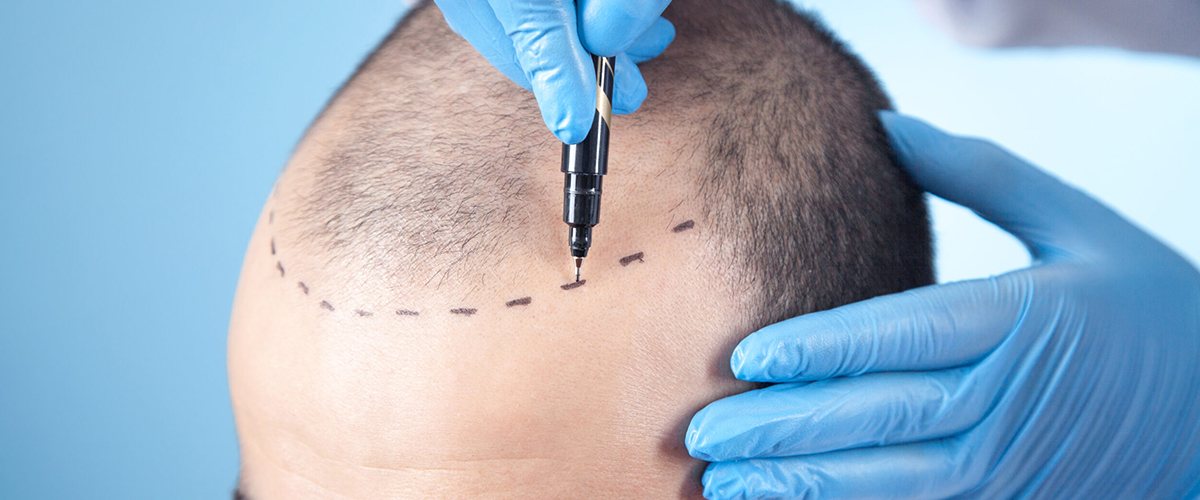
DHI Hair Transplant
DHI stands for Direct Hair Implantation. In this method, grafts are harvested and then, using a medical implanter known as a Choi pen, which should only be used by specialists, placed directly into the skin without making incisions or opening channels first. While these two steps are carried out separately in conventional hair transplant methods, the special pen combines them into one, offering the patient greater comfort and convenience. In short, the FUE technique involves three stages, whereas DHI involves two. The aim is to improve the quality of the transplant, achieve a dense result, preserve the existing hair without cutting it short, and help the patient return to daily life quickly.
How is a DHI hair transplant performed?
A DHI hair transplant is performed under local anaesthesia and can be done with or without shaving. The follicles taken from the donor area are implanted directly into the recipient area using the DHI pen.
The follicular unit taken from the donor area is loaded into the Choi needle. Follicles of suitable thickness, placed in needles of different diameters, are implanted one by one at an angle of 40–45 degrees into the area to be treated, according to the pre-planned design. As the Choi needle pushes the follicle forward, it simultaneously places it into the channel it creates in the scalp.
At least 2 Choi pens and an average of 10–12 different Choi tips are used in a DHI procedure. The tips and pens, which vary in diameter, are selected individually before the operation according to the thickness of the patient’s hair.
What are the stages?
Local anaesthesia is applied to the donor area to numb it, and the follicles are harvested with a special pen. The harvested follicles are then implanted into the scalp using this special device.
The follicles are placed into the scalp using the special Choi pen. This pen has a very fine, sharp tip that is designed to hold a hair follicle inside it. When the fine-tipped pen is inserted into the scalp at the correct angle and the plunger at the back is pressed, it places the follicle inside into the scalp.
Performed without damaging healthy tissue, this method has the advantage of allowing much denser implantation.
The main reason this method is preferred is that the follicles are implanted immediately after harvesting, without being kept waiting. This increases the survival rate and the likelihood of the grafts remaining healthy. Although it is not a new technique, its popularity has grown considerably in recent years.
The procedure takes around 10–12 hours, and it is extremely important that it is carried out by experienced professionals. As with robotic hair surgery and FUE, a check-up is carried out on the first day after the procedure. Washing starts on the second day and continues for eight days.
What are the advantages?
- Because channel opening and implantation are done at the same time, the harvested follicles can be implanted without being kept waiting for long.
- It allows much denser implantation and a much more natural look.
- The special instrument reduces the time follicles spend outside the body during the procedure, minimising the risk of graft loss.
- Existing hair is not damaged. It can also be used in patients whose hair loss has not yet stabilised.
- Patients recover quickly.
Am I a suitable candidate for DHI?
Before a DHI hair transplant, you will undergo a detailed examination. At this stage, standard surgical protocols are followed to make sure there are no health problems that would prevent the operation. The necessary tests and blood tests are carried out while the donor area is analysed.
A detailed, personalised consultation based on the patient’s age and pattern of hair loss is extremely important for anticipating future hair loss and ensuring patient satisfaction.
After a DHI hair transplant
Wound care and the first wash are carried out one or two days after the DHI procedure, and the condition of the follicles is checked. From this point on, things quickly become more comfortable. The first few days are the most delicate period after DHI. Patients can return to their home country from the second day onwards.